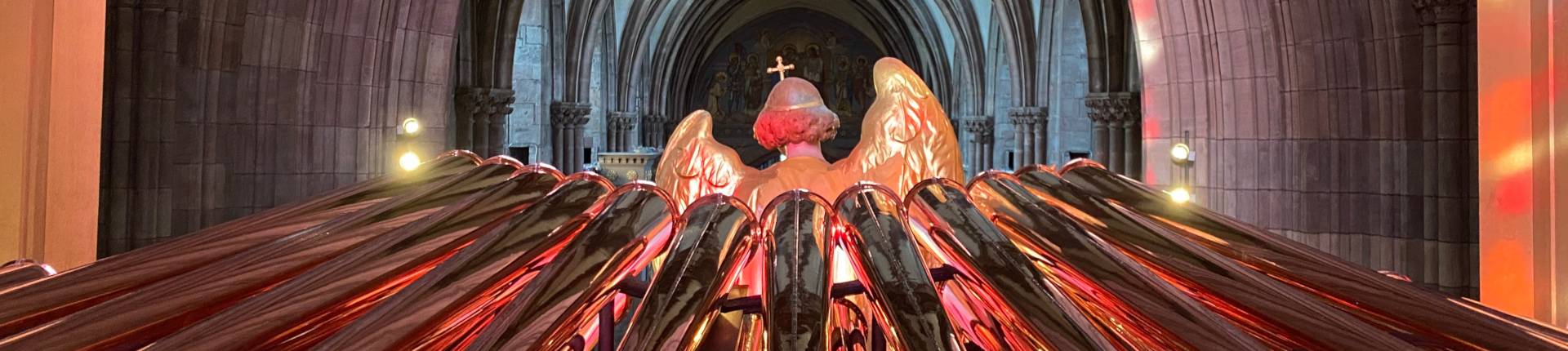

Gesamtdisposition 1929
M. Welte & Söhne, 1929
III+P / 58 (50), el./el.
| I. Hauptwerk (C-c'''') | II. Oberwerk (C-c'''') | III. Schwellwerk (C-c'''') | Pedal (C-f') |
| 1. Principal 16' | 15. Quintatön 16' | 26. Liebl. Gedackt 16' | 44. Principal 16' |
| 2. Principal 8' | 16. Geigenprincipal 8' | 27. Flötenprincipal 8' | 45. Subbaß 16' |
| 3. Nachthorn 8' | 17. Salicional 8' | 28. Äoline 8' | 46. Salicetbaß 16' |
| 4. Gemshorn 8' | 18. Unda maris 8' | 29. Vox coelestis 8' | 47. Zartbaß 16' (Tr. 26) |
| 5. Gamba 8' | 19. Rohrflöte 8' | 30. Bordun 8' (E. 26) | 48. Quintbaß 10 2/3' |
| 6. Großflöte 8' | 20. Blockflöte 4' | 31. Konzertflöte 8' | 49. Cello 8' (E. 46) |
| 7. Flöte 4' | 21. Praestant 4' | 32. Oktav 4' | 50. Oktav 8' (E. 44) |
| 8. Oktav 4' | 22. Harm. aeth. 4f. 2 2/3' | 33. Hornflöte 4' | 51. Gedacktbaß 8' (Tr. 26) |
| 9. Quinte 2 2/3' | 23. Waldflöte 2' | 34. Violine 4' | 52. Quintbaß 5 1/3' (E. 48) |
| 10. Cornett 3f. 2 2/3' | 24. Krummhorn 8' | 35. Sesquialter 2f. | 53. Choralbaß 4' |
| 11. Super Oktav 2' | 25. Englisch Horn 8' | 36. Bachflöte 2' | 54. Mixtur 5 1/3' |
| 12. Mixtur 4-6f. 2 2/3' | 37. Zimbel 3f. 4' | 55. Contra Tuba 32' (ds) | |
| 13. Trompete 8' | 38. Septime 1 1/7' | 56. Posaune 16' | |
| 14. Klarine 4' | 39. Schwiegel 1' | 57. Trompete 8' (E. 56) | |
| 40. Basson 16' | 58. Trompete 4' (E. 56) | ||
| 41. Oboe 8' | |||
| 42. Tuba 8' | |||
| 43. Zink 4' | |||
| - Tremolo - |
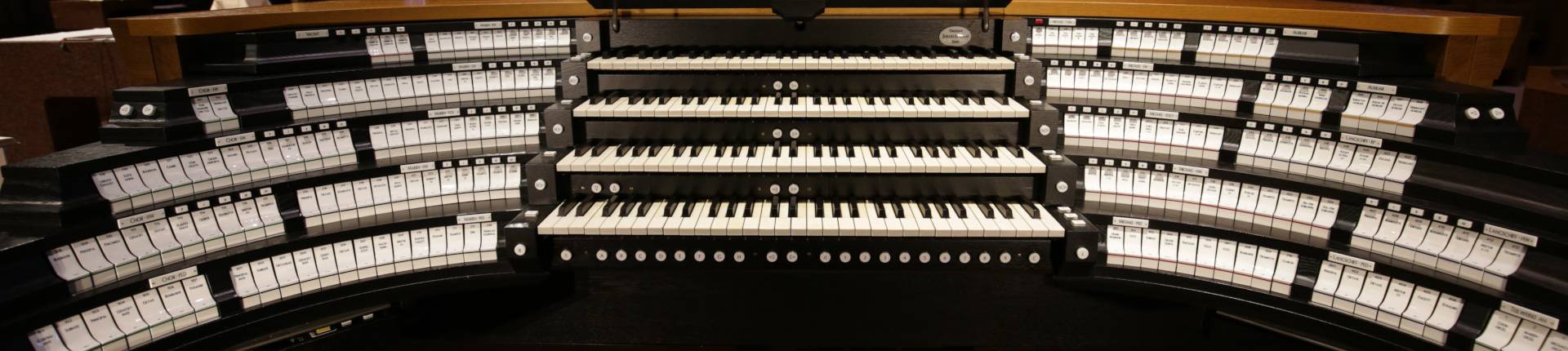
Elektropneumatische Membranenladen, vom Hauptspieltisch im Chorraum aus spielbar.
Tr. = Transmission
E. = Extension
ds = durchschlagend
Nr. 55 (Contra Tuba 32') wurde auf der Michaelsempore aufgestellt.

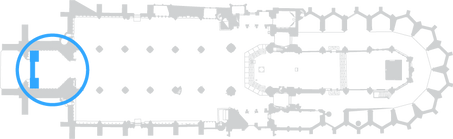
M. Welte und Söhne, 1929
| Hochdruckwerk (schwellbar) 200mm H2O (C-c''''') | Fernwerk (schwellbar) (C-c''''') | |
| 59. Principal 8' | 67. Hornprincipal 8' | |
| 60. Großflöte 8' | 68. Salicet 8' | |
| 61. Viola 8' | 69. Vox angelica 8' | |
| 62. Quintatön 4' | 70. Harmonieflöte 8' | |
| 63. Oktav 4' | 71. Echobordun 8' | |
| 64. Rauschquinte 2 2/3' + 2' | 72. Alphorn 4' | |
| 65. Tuba mirabilis 8' | 73. Echo Cornett 3f 2 2/3' | |
| 66. Clairon 4' | 74. Trompete 8' | |
| 75. Vox humana 8' | ||
| Tremolo |

E.F. Walcker, Ludwigsburg (1881)
Opus 390
II+P / 34 (33)
| I. Hauptwerk C - f"' (*) | II. Schwellwerk C - f"' | Pedal C - f’ | |||||
| Principal | 16’ | Bourdon | 16’ | Principalbaß | 16’ | ||
| Principal | 8’ | Principal | 8’ | Violonbaß | 16’ | ||
| Viola di Gamba | 8’ | Liebl. Gedackt | 8’ | Subbaß | 16’ | ||
| Concertflöte | 8’ | Salicional | 8’ | Stillgedeckt (WA) | 16' | ||
| Dolce | 8’ | Voix céleste | 8’ | Quintbaß | 10 2/3’ | ||
| Quintatön | 8’ | Aeoline | 8’ | Octavbaß | 8’ | ||
| Gedackt | 8’ | Fugara | 4’ | Violoncello | 8’ | ||
| Quinte | 5 1/3’ | Flauto dolce | 4’ | Bombardon | 16' | ||
| Octav | 4’ | Viola tremolo ab c | 8’ | Trompete | 8’ | ||
| Spitzflöte | 4’ | Clarinette (ds) | 8’ | ||||
| Rohrflöte | 4’ | ||||||
| Piccolo | 2’ | Tremolo Clarinette | II-P | ||||
| Mixtur 5fach | 2 2/3’ | Terza Mano (Octavkoppel) | I-P | ||||
| Cornett 5fach ab g | Octavkoppel | ||||||
| Trompete | 8’ | ||||||
| II-I |
Elektropneumatische Kegellade (Umbau durch Welte und Söhne, 1929)
WA = Windabschwächung
*) In den Quellen von Friedrich Kempf (1929) ist der Tonumfang mit 73 Tönen angegeben
